


Summary
As the glyphosate industry approaches a critical window ahead of 2026, multiple signals across the value chain are emerging in quick succession. Policy adjustments, downstream demand dynamics, technological upgrades, and shifts in global trade patterns are collectively reshaping market logic.
The industry is transitioning from a phase of pure inventory-driven competition toward structural optimization, where short-term pressure coexists with improving medium- to long-term fundamentals.
1. Export Tax Rebate Policy Adjustments Indirectly Strengthen Glyphosate's Competitive Position
On January 8, China's Ministry of Finance and State Taxation Administration announced the removal of VAT export rebates for several pesticide technical products, including glufosinate, refined glufosinate, and acephate, effective April 1, 2026. Glyphosate was not included in this round, as its export tax rebate had already been abolished in 2010.
The implications for glyphosate are twofold. First, as glufosinate is a core competitor to glyphosate in the non-selective herbicide segment, rising export costs will weaken its international price competitiveness, indirectly reinforcing glyphosate's market position.
Second, the policy is widely viewed as part of China's broader supply-side reform and "anti-involution" efforts in the agrochemical sector. Over the long term, it raises compliance and operational thresholds, accelerates the exit of inefficient capacity, and creates a more orderly competitive environment for leading producers.
2. Approval of Herbicide-Tolerant GM Crops Sends a Long-Term Demand Signal
On January 27, the Biotechnology Research Institute of the Chinese Academy of Agricultural Sciences announced that its domestically developed herbicide-tolerant GM corn variety GG2 had officially received a biosafety certificate for production application from the Ministry of Agriculture and Rural Affairs.
The variety demonstrates high tolerance to glyphosate, with significantly lower residue levels after application compared with similar products. As commercialization progresses, glyphosate is expected to become the primary herbicide used in crop management, potentially unlocking new demand growth.
For an industry currently operating in a stock-competition phase, this development represents a meaningful long-term demand-side variable.
3. Technological Innovation and Circular Resource Utilization Gain Momentum
On the production side, companies continue to advance process optimization focused on cost reduction and environmental performance. On January 2, Hubei Taiseng Chemical obtained a patent for a method to recover glyphosate technical and isopropylamine from glyphosate isopropylamine salt solutions.
By combining acid precipitation and alkaline distillation, the technology enables efficient separation and recycling, reducing environmental impact while improving resource efficiency. This provides a new technical pathway for more refined and circular production models in the industry.
4. Upstream Raw Materials and Capacity Layout Continue to Adjust
Leading players are actively reinforcing upstream integration around phosphorus chemistry. On January 26, Xingfa Group disclosed that its thermal-process phosphoric acid capacity stands at 150,000 t/a, with utilization exceeding 70% in 2025 and plans to expand to 225,000 t/a by 2026.
Amid rising sulfur prices, thermal-process phosphoric acid offers cost advantages over wet-process routes, and production will be flexibly adjusted based on market conditions. Increased output is also expected to support upstream yellow phosphorus pricing.
In parallel, its subsidiary Hubei Jixing Chemical has initiated construction of a new 75,000 t/a thermal-process phosphoric acid project. With environmental approval completed and civil and installation tenders underway, the project will leverage existing yellow phosphorus capacity and expand into higher value-added phosphate applications.
5. New Regulatory Framework Reshapes Market Rhythm
Regarding China's "One Certificate, One Product, One Standard" pesticide regulation set to take effect on January 1, 2026, Xingfa Group indicated that the glyphosate market may experience a "down first, up later" trajectory. In the short term, pre-policy stocking by downstream players could temporarily increase channel inventories and exert price pressure.
Over the medium to long term, however, higher compliance thresholds are expected to accelerate capacity rationalization and improve supply structure. As inventories normalize and market order improves, prices are likely to return to more rational levels. As an industry leader, Xingfa's assessment carries strong signaling value.
6. Capacity Expansion and Global Deployment Continue
Amid rising industry concentration, leading producers are accelerating both domestic expansion and overseas.
Hebang Biotechnology is fully converting its Guang'an 500,000 t/a diglyphosate capacity to glyphosate using an environmentally optimized IDA route integrated with AI-driven efficiency controls, while simultaneously advancing a 350,000 t/a project in Indonesia targeting Southeast Asian markets.
Jiangshan Co. expects its 50,000 t/a glyphosate project in Guizhou to enter trial production by the end of 2025, lifting total capacity to 120,000 t/a and further consolidating its industry position.
7. Export Structure Remains Stable with High Concentration Among Leading Players
According to Tranalysis data, China's glyphosate exports reached 38,129.71 tonnes in October 2025, equivalent to 21,150.40 tonnes on a 100% active ingredient basis. Exports were dominated by 95% glyphosate TC, 75.7% water-soluble granules, and 62% glyphosate IPA.
Major exporters included Zhejiang Xinan Chemical, Hubei Taiseng Chemical, and Nantong Jiangshan Agrochemical, with Brazil, the United States, and Argentina as the primary destinations—underscoring continued international demand support.
Editor's Insight: Short-Term Pressure, Long-Term Structural Improvement
Overall, the glyphosate market remains in a critical transition phase ahead of 2026, with elevated inventories and softer demand weighing on short-term pricing. However, tightening regulations, technological progress, evolving demand fundamentals, and sustained investment by leading producers are collectively reshaping the industry's structural foundation. The competitive landscape is shifting from price-driven cycles toward structural competition, laying the groundwork for more sustainable long-term performance.
For industry participants, the key at this stage lies not in short-term price fluctuations, but in continuous tracking of policy timing, capacity evolution, and changes in corporate competitiveness.
Access the Full Analysis: Glyphosate January Monthly Report
This article presents selected highlights from the Glyphosate January Monthly Report. The full report offers deeper insights into market trends, corporate developments, regulatory and registration dynamics, trade structures, and price monitoring.
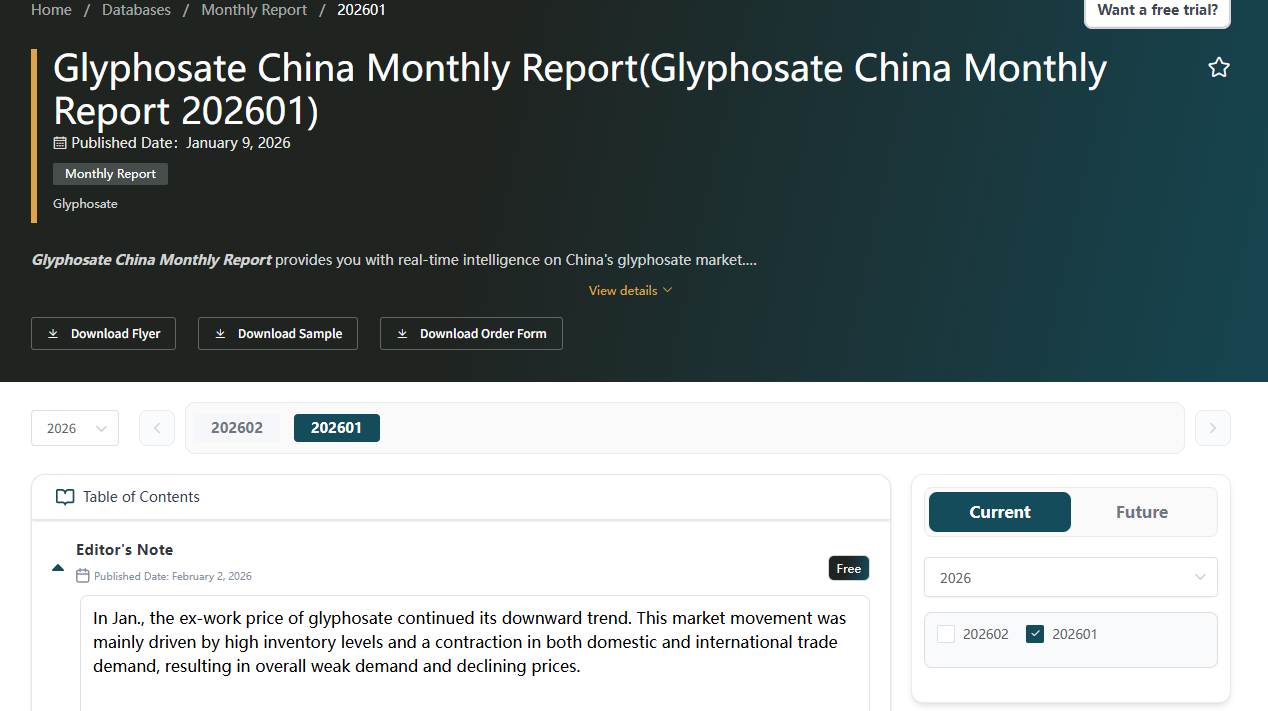
Through consistent monthly updates and long-term data accumulation, we help industry stakeholders cut through information noise and build a structured, forward-looking understanding of the glyphosate market.
Source: CCM-Cnchemicals
About CCM
CCM is the leading market intelligence provider for China's agriculture, chemicals, food & feed and life science industries. Founded in 2001, CCM provides price monitoring, trade analysis and customized market research. CCM also offers advertising and promotional services for food ingredient and sweetener suppliers, helping companies enhance visibility and connect with targeted global buyers.
Website: www.cnchemicals.com | Email: econtact@cnchemicals.com | Tel: +86-20-37616606