


Summary:
The opening months of 2026 have brought multiple structural changes to China’s seed and grain import markets. Total grain imports grew modestly in January–February, while corn, wheat and rice imports surged sharply. Seed imports and exports saw seasonal declines. At the same time, the seed industry’s capitalisation accelerated – Zhengda Seeds became the first foreign-controlled seed company to list on China’s A-share market, and Kangnong Seeds released its 2025 earnings. On the policy front, Sichuan and Zhejiang provinces rolled out new measures for seed industry revitalisation and reserve security, adding fresh momentum to national food security.
1. January 2026 Seed Trade: Seasonal Dip, Vegetable Seeds Still Dominant
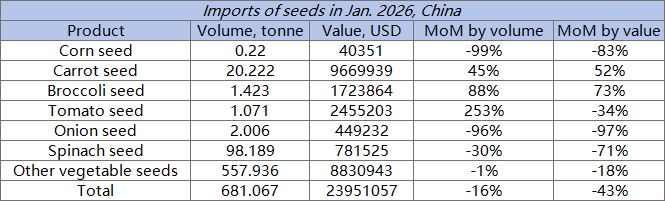
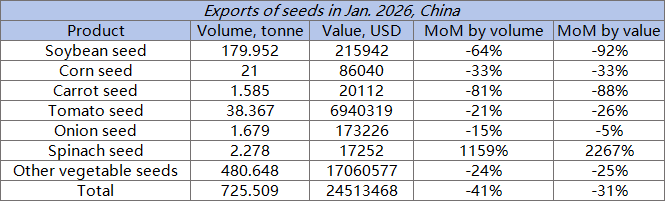
According to GACC data, China imported a total of 681.07 tonnes of soybean, corn and vegetable seeds in January 2026, down 15.66% month-on-month (MoM), with a total value of US$23.95 million, down 43.33% MoM. Exports fell 40.62% MoM to 725.51 tonnes, valued at US$24.51 million.
By category:
-
Soybean & corn seeds: Imports plunged 99.45% MoM to just 0.22 tonnes (US$40,400); exports fell 61.83% MoM to 200.95 tonnes (US$302,000).
-
Vegetable seeds (carrot, broccoli, onion, tomato): Imports of 122.91 tonnes, down 39.25% MoM, valued at US$15.08 million; exports of 43.91 tonnes, down 25.49% MoM, valued at US$7.15 million.
-
Other vegetable seeds: Imports of 577.94 tonnes, down 1.24% MoM, valued at US$8.83 million; exports of 480.65 tonnes, down 24.48% MoM, valued at US$17.06 million.
Vegetable seeds accounted for the lion’s share of both import and export values, reflecting China’s continued reliance on high-end imported vegetable seeds while maintaining solid competitiveness in conventional vegetable seed exports.
2. Jan–Feb Grain Imports: +3.12% Total Volume, Sharp Rises for Corn, Wheat, Rice
In the first two months of 2026, China imported approximately 17.379 million tonnes of major grains, up 3.12% year-on-year (YoY). February imports alone were 8.004 million tonnes, down 14.63% MoM.
Breakdown by variety:
-
Soybean: 12.547 million tonnes (72.20% of total), down 7.78% YoY
-
Corn: 545,000 tonnes (3.13%), up 208.16% YoY
-
Wheat: 1.275 million tonnes (7.34%), up 1,277.58% YoY
-
Barley: 2.156 million tonnes (12.40%), up 27.41% YoY
-
Sorghum: 272,000 tonnes (1.56%), down 73.02% YoY
-
Rice: 585,000 tonnes (3.37%), up 110.05% YoY
Drivers behind the surges:
-
Corn: The sharp rise in corn imports was driven by a domestic quality gap. Persistent rains in main production areas during the 2025 autumn harvest led to elevated levels of mycotoxins (e.g., vomitoxin). Feed mills turned to imported corn to ensure quality and safety.
-
Wheat: The more than 12-fold increase reflected both strong feed substitution demand and attractive international prices.
-
Barley: Benefited from the full recovery of Australian supply, which accounted for nearly 80% of Jan–Feb imports. The zero-tariff policy has reinstated Australia as the dominant supplier, with concentrated arrivals matching post-holiday restocking needs.
-
Rice: Doubled due to persistently low global rice prices. Southeast Asian suppliers – Myanmar, Vietnam, Pakistan – were the main sources, with import prices below those of comparable domestic rice, boosting buyer appetite.
Overall, Jan–Feb grain imports showed “stable total volume, divergent structure”. Declines in soybean and sorghum were tied to supply timing and substitution effects, while the rises in wheat, corn and rice corresponded respectively to feed substitution, quality gaps, and international price advantages.
3. A Capitalisation Milestone: Zhengda Seeds Becomes First Foreign-Controlled Listed Seed Company
On 13 March, the Beijing Stock Exchange Listing Committee approved the initial public offering (IPO) application of Xiangyang Zhengda Seed Co., Ltd. (Zhengda Seeds). Zhengda Seeds thus became the first foreign-controlled seed company to list on China’s domestic A-share market.
The company plans to issue no more than 48.0495 million shares, raising approximately RMB 283 million (US$40.87 million). Proceeds will mainly fund the Yunnan Zhengda Seed Processing Center project and the second phase of the Zhangye Zhengda Charoen Pokphand corn seed processing project.
Company strengths:
-
Zhengda Seeds is an integrated “breeding-propagation-promotion” corn seed enterprise. It has established stable seed production bases in Zhangye (Gansu), Qingtongxia (Ningxia), Yuxi (Yunnan) and elsewhere, with annual production area stable at over 50,000 mu (approx. 3,333 hectares). It operates three large seed processing centres in Xiangyang (Hubei), Yuxi and Zhangye, with total annual processing capacity of 50,000 tonnes.
-
As of 30 June 2025, the company had set up eight core breeding research stations across China’s major corn ecological zones, obtained 67 new plant variety rights, and had 74 approved corn varieties on the market.
-
Its self-bred variety Zhengda 808 was included in the Ministry of Agriculture and Rural Affairs’ 2023 “National Catalogue of Excellent Crop Varieties for Promotion” as a “backbone promotion variety”. Zhengda 808, 719, 619 and others have been named leading varieties in several provinces.
-
According to the China Crop Seed Industry Development Report, Zhengda Seeds ranked 10th in total sales revenue among national hybrid corn seed enterprises in 2023, and among the top five listed seed companies in terms of net profit.
-
Financially, the company achieved operating revenue of RMB 361 million (US$52.14 million) in 2025, with net profit attributable to parent company of RMB 90.75 million (US$13.11 million), up 11.85% YoY. By optimising production processes and improving supply chain efficiency, operating costs fell 13.87% YoY, while administrative expenses were cut by 21.10%.
Zhengda Seeds’ successful listing marks a breakthrough for foreign-controlled seed enterprises accessing China’s A-share market and is expected to further energise capital flows into the seed sector.
4. Kangnong Seeds 2025 Results: Revenue +7.43%, Recurring Net Profit +15.52%
On 27 February, Hubei Kangnong Seeds Co., Ltd. released its 2025 preliminary earnings. The company posted operating revenue of RMB 362 million (US$52.24 million), up 7.43% YoY; net profit attributable to parent of RMB 80.31 million (US$15.10 million), down 2.78% YoY; and recurring net profit (excluding non-recurring items) of RMB 69.89 million (US$10.09 million), up 15.52% YoY.
Reasons for the changes:
-
Revenue growth: The hybrid corn variety “Kangnong Yu 8009” continued to perform well in the Huang-Huai-Hai summer sowing region, gaining wide recognition from distributors and farmers. Sales volumes increased further in 2025.
-
Attributable net profit decline: Mainly due to a year-on-year increase in inventory write-downs, coupled with lower non-operating income and other gains.
-
Recurring net profit growth: Lower overall seed production costs in the main production bases of Northwest China boosted gross margins for hybrid corn seeds. Meanwhile, stronger accounts receivable management reduced expected credit impairment losses.
Kangnong’s results underscore the market competitiveness of strong corn varieties and the positive impact of cost control on profitability.
5. Sichuan’s “No.1 Document” Lays Out Four Major Seed & Grain Initiatives
On 2 March, the Sichuan provincial government held a press conference on the 2026 Provincial Party Committee No.1 Document. Jiang Gang, Director of the Provincial Department of Agriculture and Rural Affairs, announced four major measures to ensure grain planted area remains stable at over 6.4 million hectares and grain output at over 36.5 billion kg:
-
Stabilise area: Strengthen controls on farmland use; continue provincial fiscal subsidies for large grain growers – RMB 1,400/hectare (US$202.21) in plain areas and RMB 3,000/hectare (US$433.30) in hilly and mountainous areas.
-
Optimise structure: Steadily increase rice area, consolidate corn production capacity, and raise the potential of soybean and tuber yields. Organise the 8th “Rice Fragrance Cup” high-quality rice competition and build 66,700 hectares of high-end rice supply base.
-
Raise yields: Advance the “Tianfu Granary” project – build or expand 3,000 high-yield grain and oil demonstration zones, promote major crop variety adoption, support 60 counties in whole-county yield improvement, and aim to raise average grain yield by at least 1 kg per hectare.
-
Boost efficiency: Create nine provincial-level integrated grain and oil industry demonstration zones; continue production incentives; implement full-cost insurance and revenue insurance for rice, wheat, corn and soybean to stabilise farmers’ income expectations.
On technology and innovation, Sichuan will accelerate Chuannan Seed Revitalisation, implement a new round of modern seed industry enhancement projects, push forward the Wan’an Laboratory, and launch major special research programmes in biotech breeding. During the 15th Five-Year Plan period, the province plans to breed more than 50 breakthrough new varieties. It will also implement a new three-year “Tianfu Good Machinery” action, develop smart agriculture, and support the construction of smart agriculture leading zones to provide technical support for yield increases.
6. Zhejiang Province Commits RMB 6.1 Million to Provincial Seed Reserve Procurement
On 27 February, the China Government Procurement Network announced that the Zhejiang Provincial Department of Agriculture and Rural Affairs had launched its 2026–2027 provincial crop seed reserve procurement project. The project will invest RMB 6.1 million (US$881,000) to stockpile a total of 2.302 million kg of early rice, late rice, soybean, corn and rapeseed seeds, for disaster relief and market risk mitigation.
Because several reserved varieties are exclusively supplied by specific enterprises, the project adopts a single-source procurement method, assigning six suppliers to different lots:
-
Zhejiang Wunongzhong Seed: Supplies early rice, late rice, soybean, corn and rapeseed – exclusive varieties include Zhongzao 39, Zhongzu 18, Jia 67, Zhehexiang 2, Zhenong 6, Xiaonong Qiuyan, Zhekenuo 101, Zheyou 51, etc.
-
Zhejiang Nongke Seed: Supplies early rice, late rice and rapeseed – exclusive varieties include Zhongzu 53, Zhehujing 25, Zheyou 50, etc.
-
Longyou Wuguxiang Seed (Zhejiang): Supplies early rice – exclusive variety Zhongzu 100.
-
Zhejiang Dahe Seed: Supplies late rice – exclusive varieties Zhejing 147, Xinhexiang 1.
-
Zhejiang Kedefeng Seed: Supplies early rice – exclusive variety Jiazaofeng 19.
-
Wenzhou Xinfeng Seed: Supplies early rice – exclusive variety Zhe 1831.
The regular operation of provincial seed reserve procurement provides an essential buffer against natural disasters and market volatility.
Source from Seed China Monthly Report
This is a snapshot of key trends in China’s seed industry for March 2026. Our full monthly report includes weekly price trends for complete overseas trade data, detailed corporate project updates, supply-demand balance sheets and in-depth chain analysis—empowering you to spot market turning points and optimize procurement & investment decisions. Subscribe now to access full core data and exclusive insights for smarter business moves!
About CCM
CCM is the leading market intelligence provider for China's agriculture, chemicals, food & feed and life science industries. Founded in 2001, CCM provides price monitoring, trade analysis and customized market research. CCM also offers advertising and promotional services for food ingredient and sweetener suppliers, helping companies enhance visibility and connect with targeted global buyers.
Website: www.cnchemicals.com | Email: econtact@cnchemicals.com | Tel: +86-20-37616606